For a lyrical and clever take on the symbolization of forms and dreams check out the following:
http://www.youtube.com/watch?v=2_HXUhShhmY
Enjoy and thanks to all for a stimulating class on Thursday.
Saturday, January 31, 2009

Thursday, January 29, 2009
why at all?
Why do I respond at all?
I sit here in my studio looking over at the Makita drill case. It is blue. It has form. It has lines. But I am not inspired. I am not aroused. The small statues in the Opera Bastille by the artist Yves Cline, they too, are blue. They have form. They have lines. But they are exalting. What is it that separates the one blue form from the other? Why do I respond intensely to one but not to the other?
These are questions put before us by theorists and philosophers and artists. For Kant, it was a matter of knowledge, feeling and desire.
In the article by Vischer, a post-Kantian, brings in the sensual with the formal aesthetics. He brings the drive for unity of idea and and emotion. He brings into thought the combination of "immediate feeling" and a kinesthetic 'responsive feeling'...between a sensory and kinesthetic empathy." Vischer expounds on these ideas in how we feel about what we see. The physical use of our eyes, scanning the images, caressing the images with our retinas as we would with our hands. The perception of what we are looking at is taken in both mentally and physically. The sensation is both immediate and responsive. The kinesthetic stimulus always leads to the idea. These ideas can be brought about by dreams as well as the imagination. We respond with an empathetic sensation.
Drill case or Yves Kline statues? I will see to satisfy my need for pleasure and go with Kline's cobalt blue goddesses.
ns
How does one empathize with an inanimate object? Is it when an art piece provokes a feeling in a viewer? Or does a viewer empathize with an artist through a work of art? Does a work of art have to have conceptual meaning to it in order for a viewer to have empathy towards it? Seeing is the basis of being able to appreciate a work of art, and understanding its meaning is secondary.
I was more able to relate to the article written by Mundt. It is a nice overview of the other authors works. I agree with Kant in his writings,"...in pure judgement of the pleasure created by the object has to do with form". Being a artist my self coming from a purely aesthetic back ground I was intrigued by Kant's theories. "....judgement of taste can only refer to form." I can relate to this statement because initially I am visually attracted to a work of art. I have seen many ugly poorly executed "conceptual" works of art that I have no care to view. I feel that no matter how much content a piece of crappy art has in the end it is still a crappy piece of art. Throughout my education of art I have come to really heavily on proportions, placement and colors in works of art in order to respect and appreciate art. Which leads me to a quote from Herbert, "...proportions and relations on which rest the power of a work of art". I don't believe that a work of art has to have content. It is good to have a aesthetically pleasing work of art that also has a message involved, but a form doe's not need content to be appreciated. For me content in a work of art has to be paired with aesthetics in order for me to appreciate it. Being able to see is the foundation of appreciating a "visual" work of art. Right? haha
Confused Fusion
One needs the entire spectrum of sensory and imaginary tools to experience the empathy theory, and feel art in the complete and “true” aesthetic realm. For one to truly experience art, it must be done through all physical and psychological means, is an argument I can easily swallow. It tastes quite good and is filled with logical and palpable explanations. The issue becomes a little bit more problematic when I am offered a sense of false Symbiosis (Living together of unlike organisms) as the conclusion [apotheose] of the argument. The artwork and the self merging as “one hand claps another.”(104) My problem is not so much with the phenomenon itself but rather with the lack of explanation as to how it is taking place. When does this symbiotic experience occur? Is it organic? Voluntary? It remains unclear to me after reading Vischer. After all it is only theory and must be seen and read as such. Vischer states, “Thus I project my own life into the lifeless form (104) and “…I am mysteriously transplanted and magically transformed into this other.”(104) I remember using the word “Magically” in an art history thesis statement once. I received a response from my professor clearly stating that “magically” strongly weakened the validity and weight of my argument. Here Vischer uses both Magically and Mysteriously. Ah! The plot thickens!
Ok, enough of close reading and let me accept the theory at face value in order to unveil the issues that could possibly rise from it?
If the viewer needs to become “the object” in order to aesthetically “see it” then what is a work of art becomes in question too. When the line of what the artwork is becomes non-existent we fall into a notion that everything is art and art is everything. Which creates a problem when we talk of Aesthetics. This very fusion nullifies what the very notion of art would be to Vischel and confuses the argument itself.

In symbiosis the clownfish never becomes the Anemone, though they mutually benefit from each other’s existence. The clownfish protects the anemone with its bright colors and the anemone protects the clown fish with its ability to sting. The artwork benefits from the existence of the viewer (transmission to others of its meaning) and the viewer benefits from the experience of the artwork (transmission to his senses of the artworks meaning). To fuse the two becomes a confused proposition, no pun intended.
To project our “own physical form into an objective form”(104) can arguably help us to understand it but to “incorporate”(104) that same form would destroy it as something unique. If everything is unique then nothing is.
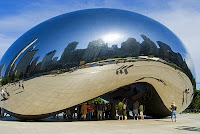 A good example of an artwork addressing this issue of symbiosis without stepping in the dangerous realm of nonsensical confusion is “Cloud Gate” (aka The Bean) by Anish Kapoor in Millemium Park, Chicago. This sculpture addresses the issue of the Chicago skyline and the reflection of the world in cotemporary times, but it also engages the viewer in a reflection of “the self” in this contemporary world. One becomes part of the artwork yet is still distinct and free from it. This temporary experience gradually dissolves when one walks away from the sculpture. But the mirrored mercury drop inspired sculpture concretely offers the opportunity to “incorporate our own physical form into an objective form” (104) if only for a time.
Ok, enough of close reading and let me accept the theory at face value in order to unveil the issues that could possibly rise from it?
If the viewer needs to become “the object” in order to aesthetically “see it” then what is a work of art becomes in question too. When the line of what the artwork is becomes non-existent we fall into a notion that everything is art and art is everything. Which creates a problem when we talk of Aesthetics. This very fusion nullifies what the very notion of art would be to Vischel and confuses the argument itself.

In symbiosis the clownfish never becomes the Anemone, though they mutually benefit from each other’s existence. The clownfish protects the anemone with its bright colors and the anemone protects the clown fish with its ability to sting. The artwork benefits from the existence of the viewer (transmission to others of its meaning) and the viewer benefits from the experience of the artwork (transmission to his senses of the artworks meaning). To fuse the two becomes a confused proposition, no pun intended.
To project our “own physical form into an objective form”(104) can arguably help us to understand it but to “incorporate”(104) that same form would destroy it as something unique. If everything is unique then nothing is.
 A good example of an artwork addressing this issue of symbiosis without stepping in the dangerous realm of nonsensical confusion is “Cloud Gate” (aka The Bean) by Anish Kapoor in Millemium Park, Chicago. This sculpture addresses the issue of the Chicago skyline and the reflection of the world in cotemporary times, but it also engages the viewer in a reflection of “the self” in this contemporary world. One becomes part of the artwork yet is still distinct and free from it. This temporary experience gradually dissolves when one walks away from the sculpture. But the mirrored mercury drop inspired sculpture concretely offers the opportunity to “incorporate our own physical form into an objective form” (104) if only for a time.
The Need to Connect
It is natural for humans to project their experiences and knowledge upon an object. This determines the definition of that object, for the viewer. This concept is discussed both by Vischer and Mundt.
In Three Aspects of German Aesthetic Theory, Mudnt approaches the topic by specifically labeling the three theories of viewing art, as idealist, formalist and sensualist.
In Empathy, Form, and Space- Problems in German Aesthetics, Vischer expounds on these theories with a more practical approach.
The preface explains that the work “was prompted by the discussion of pure form” (pg. 89). As I read the pages of this text it became evident the concept of pure form has many dimensions, steering towards non existence. Artists and those who are not, view forms, projecting their experiences, imagination. Vischner states, we “involuntarily read our emotions into them”, which is referred to as empathy. “It finds in everything a counterpart to itself and a symbol of its humanity.”(pg. 92)
The desire to connect or relate to an object is instinctive, in order for it to be good, understood or identified. One can find this in art, politics and music. However, Vischer explains the “effect of light and color, the contour, and the pure line cannot be described by empathy.” (pg. 92)
The discussion of sensory versus kinesthetic stimuli delves into the mental and physical stimulus upon viewing an object. Vischer also discusses the participation of touch in seeing an object, as well as distance. He illustrates with an example of a blind person. I reflect on my first memorable experience of visiting a museum and the strong desire to brush my fingers across a sculpture, which seemed within my reach. The desire to touch persists in my experiences of viewing art and my desire to connect.
In Three Aspects of German Aesthetic Theory, Mudnt approaches the topic by specifically labeling the three theories of viewing art, as idealist, formalist and sensualist.
In Empathy, Form, and Space- Problems in German Aesthetics, Vischer expounds on these theories with a more practical approach.
The preface explains that the work “was prompted by the discussion of pure form” (pg. 89). As I read the pages of this text it became evident the concept of pure form has many dimensions, steering towards non existence. Artists and those who are not, view forms, projecting their experiences, imagination. Vischner states, we “involuntarily read our emotions into them”, which is referred to as empathy. “It finds in everything a counterpart to itself and a symbol of its humanity.”(pg. 92)
The desire to connect or relate to an object is instinctive, in order for it to be good, understood or identified. One can find this in art, politics and music. However, Vischer explains the “effect of light and color, the contour, and the pure line cannot be described by empathy.” (pg. 92)
The discussion of sensory versus kinesthetic stimuli delves into the mental and physical stimulus upon viewing an object. Vischer also discusses the participation of touch in seeing an object, as well as distance. He illustrates with an example of a blind person. I reflect on my first memorable experience of visiting a museum and the strong desire to brush my fingers across a sculpture, which seemed within my reach. The desire to touch persists in my experiences of viewing art and my desire to connect.
Wednesday, January 28, 2009
Empathy
What is the beauty of art? It seems that I found some explanations in Mundt’s article. And I like Vischer’s words a lot.
Idealist thinks that the beautiful is the revelation of liberty in Nature. Formalist thinks that the beautiful is not in the representation of an idea but solely in mathematical, formal relations. (P8) Vischer stands the monumental sentence: “The artist is the content of the work of art”. (P6) Zimmermann stated “the aesthetic spirit differs from the unaesthetic one by the how, not by what, of his imagination, his summarizing, feeling, thinking.”
So I think the form and the content of a work should accord with the feeling that can be brought to the viewers also.
(P7) Vischer says “pure forms...they please me because they favor the approaches, circumnavigations and transpositions of the imagination, because they generates in me a harmonious process of feeling.”
In Maya Lin’s Vietnam Veterans Memorial, the geometric form extending to the ground and the reflecting black marble are all representing the mourning feeling of the Vietnam War. So it’s also the expression of empathy.
(P8) Robert Vischer produced the idea of empathy. “The reason for this remarkable union of subject and object is an emotionally conception… weighted conception…The pantheist desire toward a union with the world is the basis of this symbolizing activity”
What are all those forms to me through which the red blood of life does not flow?
I was struck by Vischer's description of seeing; simple seeing, and scanning. It brought to mind the idea that artists try to see the world with the eyes of a child. Seeing forms without all the associated ideas that our brains automatically attach to them is an ideal that many artists strive for. Vischer also mentions the crucial role that touch plays in helping us to see, and that indeed all children learn to see in part by touching. I would also add taste, because every child also goes through a period when everything goes straight to the mouth.
When Vischer talks about the science of seeing, the symetry of the optical nerves etc. I think about all the optical tricks and games that are now standard fair at science centers. He mentions the aftereffects of colors and indeed I found this example on the Exploratorium's website. http://www.exploratorium.edu/exhibits/bird_in_a_cage/bird_in_a_cage.html
When thinking about empathy it's rather easy as Vischer points out to empathize with another living person, but how do you empathize with an inanimate object? I think we've all had moments when we feel connected to the universe, but this is surely just a brief encounter that happens only a few times in a lifetime. Paul Klee came to mind as an artist that was able to show through simple symbols and colors the interconnectedness of people and inanimate objects.

Paul Klee "Carnival in the Mountains" 1924
When Vischer talks about the science of seeing, the symetry of the optical nerves etc. I think about all the optical tricks and games that are now standard fair at science centers. He mentions the aftereffects of colors and indeed I found this example on the Exploratorium's website. http://www.exploratorium.edu/exhibits/bird_in_a_cage/bird_in_a_cage.html
When thinking about empathy it's rather easy as Vischer points out to empathize with another living person, but how do you empathize with an inanimate object? I think we've all had moments when we feel connected to the universe, but this is surely just a brief encounter that happens only a few times in a lifetime. Paul Klee came to mind as an artist that was able to show through simple symbols and colors the interconnectedness of people and inanimate objects.

Paul Klee "Carnival in the Mountains" 1924
Subscribe to:
Posts (Atom)